Apartment Layout Decoder
Confused by real estate jargon? Select a term to see exactly what it means and how it compares.
Definition: The "T" stands for Type or Total. The number indicates primary habitable rooms.
Composition: Typically includes 2 Bedrooms + 1 Living Room. Kitchens and bathrooms are usually excluded from the count unless part of an open-plan living area.
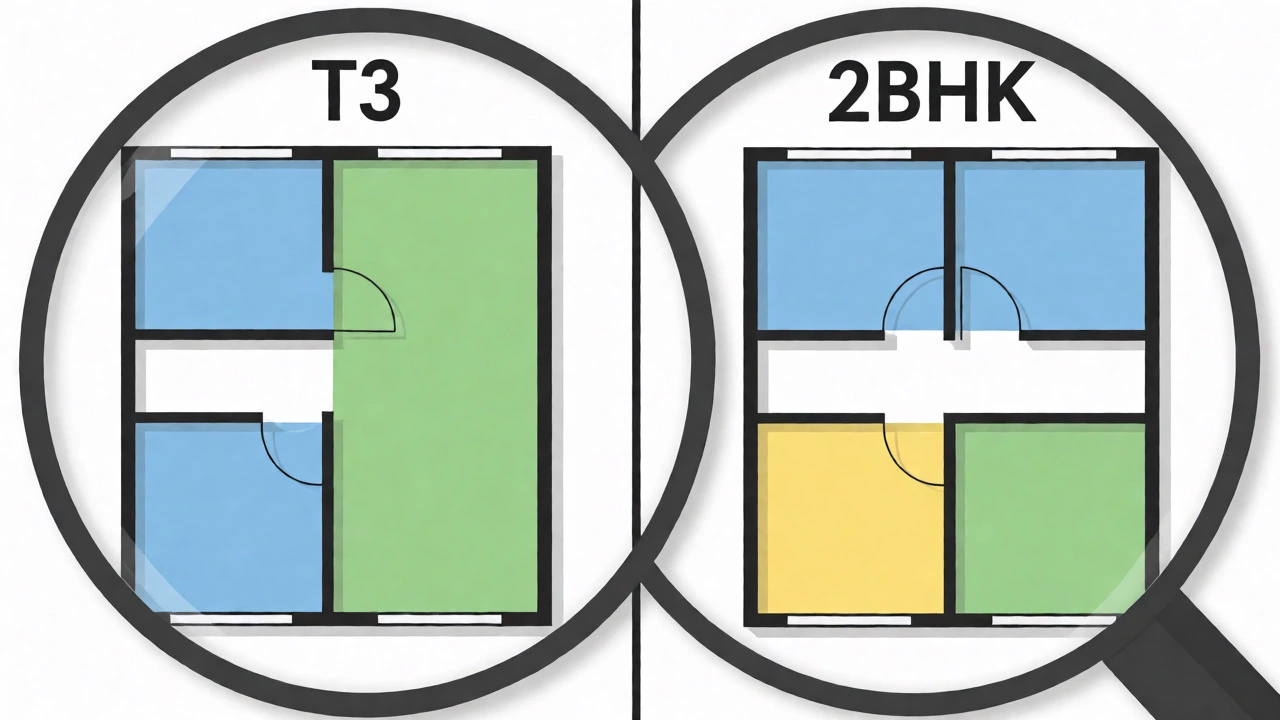
Common Pitfall: Do not confuse this with a 3-bedroom apartment. A T3 is functionally equivalent to a 2BHK in India or a 2BR in the US/UK.
You’re scrolling through property listings, and you see it: "T3 Apartment for Sale." You know what a two-bedroom flat is, but the term "T3" throws you off. Is it different from a standard 2BHK? Does it mean three rooms total? Or does it refer to something else entirely?
Here’s the quick truth: T3 is a common shorthand in many European and international markets (and increasingly in global real estate databases) for an apartment with three main habitable spaces, typically consisting of two bedrooms and one living room. In India, where the term "2BHK" dominates, a T3 is essentially the functional equivalent of a 2BHK. But why the difference in naming? And more importantly, does understanding this distinction help you buy or rent better?
| Term | Primary Region | Typical Composition | Common Confusion |
|---|---|---|---|
| T3 | France, Spain, Portugal, International Databases | 2 Bedrooms + 1 Living Room | Mistaken for 3 bedrooms |
| 2BHK | India, parts of Southeast Asia | 2 Bedrooms + 1 Hall (Living) + 1 Kitchen | Often assumed to include kitchen as a "room" |
| 2BR | USA, UK, Canada | 2 Bedrooms + Open Plan/Living Area | Focuses only on sleeping quarters |
Decoding the "T" in T3
The letter "T" stands for "Type" or sometimes "Total," depending on who you ask. The number following it indicates the count of primary rooms used for daily living. This system originated in France and spread across Southern Europe and Latin America before being adopted by international property portals like Idealista or Fotocasa, which often list properties globally.
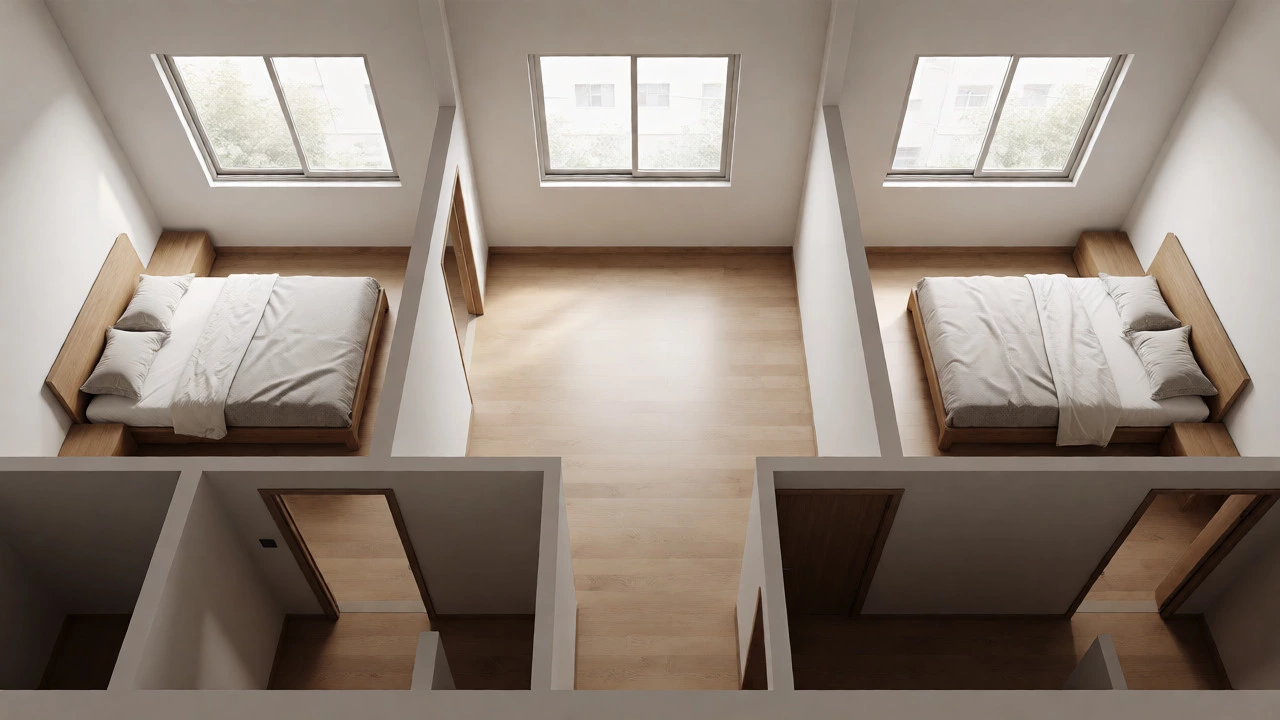
So, when you see T3, it specifically counts the master bedroom, the second bedroom, and the living room. It usually excludes the kitchen, bathrooms, hallways, and storage closets. This is crucial because it differs from how we might casually count rooms. If you walk into a T3, you expect three distinct doors leading to significant spaces: sleep, sleep again, and relax.
Why does this matter? Because if you are comparing a "T3" listing in Barcelona with a "2BHK" listing in Mumbai, you are likely looking at very similar square footage and utility. However, if you mistake a T3 for a 3-bedroom apartment, you might be disappointed when you realize there is no third bedroom for guests or a home office.
T3 vs. 2BHK: Are They Exactly the Same?
In practice, yes. But in nuance, not always. The term 2BHK is deeply rooted in Indian real estate culture, where the "Hall" (living room) and "Kitchen" are explicitly named in the acronym. The "K" stands for Kitchen. So, 2BHK = 2 Bedrooms, 1 Hall, 1 Kitchen.
A T3 doesn’t explicitly promise a separate kitchen. In modern open-plan designs, the kitchen might be integrated into the living area. If the living area and kitchen are combined into one large open space, some agents might still call it a T3 because they count the combined zone as the "living" room. Others might argue it’s a T2 if the kitchen is fully enclosed and small. Always check the floor plan.
Here is a rule of thumb: If the listing says T3, assume two private sleeping areas and one communal gathering space. If it says 2BHK, assume the same, plus a dedicated cooking space that may or may not be open to the living area.
Who Should Buy or Rent a T3?
Understanding what a T3 is helps you decide if it fits your life stage. It’s not just about semantics; it’s about space allocation.
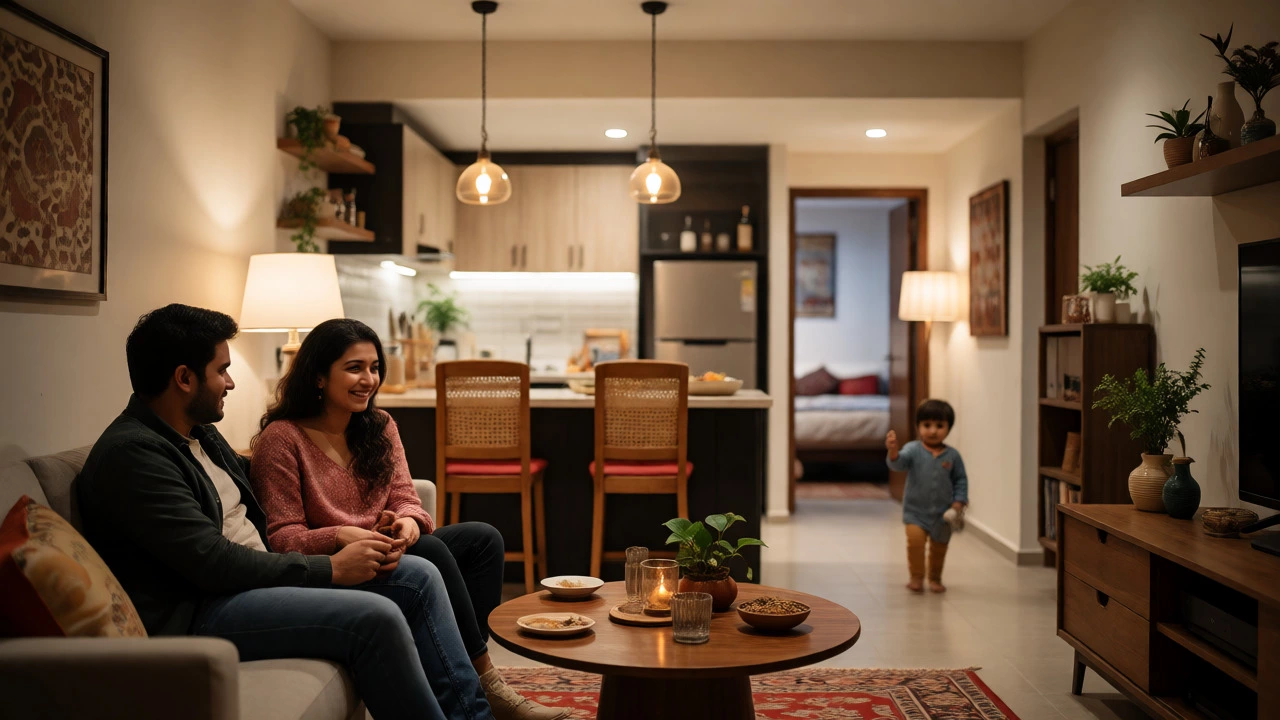
- Small Families: A couple with one child is the classic T3 demographic. You have a master suite, a nursery/kid’s room, and a living room for family time.
- Remote Workers: If you need a dedicated home office, a T3 can work if you convert the second bedroom into a workspace. But be careful-you lose guest capacity.
- Couples Without Kids: Many couples choose T3s to have a spare room for hobbies, gym equipment, or future planning. It offers flexibility that a T2 (1 Bedroom + Living) lacks.
- Investors: T3 apartments often have higher resale value than T2s in urban centers because they appeal to a broader market, including families and professionals needing extra space.
Conversely, if you are a single professional who spends little time at home, a T3 might feel like wasted money. You’ll pay heating, cleaning, and maintenance costs for a room you rarely use.
Pitfalls When Buying a T3
Don’t let the label fool you. Real estate agents love abbreviations, but they don’t always reflect reality. Here are three traps to avoid.
1. The "Converted" Third Room
Some older buildings had large living rooms that were later partitioned to create a third bedroom. Technically, this might make it a T4 (if counted as 3 bedrooms + living) or remain a T3 if the original layout was preserved on paper. Check if the partition wall is permanent or drywall. Drywall partitions offer poor soundproofing and insulation.
2. The Tiny Second Bedroom
In some compact city apartments, the second "bedroom" is barely big enough for a twin bed. It’s technically a bedroom, but calling it a T3 implies usability. Measure the room. Can you fit a wardrobe and a desk? If not, it’s effectively a study, not a bedroom.
3. Light and Ventilation
A T3 should ideally have cross-ventilation. If all three main rooms face the same direction (e.g., all facing a noisy street), the apartment will feel stuffy. Look for dual-aspect apartments where the living room faces one way and the bedrooms face another.
How to Verify the Layout Before Visiting
Never rely solely on the title "T3." Use these steps to confirm what you’re getting.
- Request the Floor Plan: Ask for a scaled drawing. Count the doors. Ensure the "living room" isn’t actually a hallway.
- Check Square Footage per Room: Divide the total area by the number of rooms. If the average room size is under 10 square meters, the T3 label might be misleading.
- Ask About Modifications: Has the owner converted a balcony into a room? Some regions allow this, adding a "room" without changing the official classification. This can affect legality and resale.
- Compare with Local Standards: In London, a 2-bed flat is standard. In Paris, a T3 is standard. If you’re moving between countries, adjust your expectations for size. A T3 in Tokyo might be half the size of a T3 in Texas.
Price Implications: Does T3 Cost More Than 2BHK?
Generally, a T3 commands a premium over a T2 (1-bedroom) but less than a T4 (3-bedroom). Compared to a 2BHK in India, the price depends heavily on location and amenities. In major metros like Bangalore or Mumbai, a well-connected T3/2BHK can cost upwards of ₹80 lakhs to ₹1.5 crores. In Europe, prices vary wildly-€300,000 in rural France versus €600,000+ in central Madrid.
The key driver isn’t just the label; it’s the efficiency. A poorly designed T3 with long corridors wastes space. A well-designed 2BHK with an open kitchen feels larger. Focus on usable space, not just room count.
Final Thoughts: Clarity Over Jargon
Knowing that a T3 equals two bedrooms and a living room saves you confusion. It aligns your expectations with reality. Whether you call it T3, 2BHK, or 2BR, the core question remains: Does this space support your lifestyle? Do you need two true bedrooms, or would a large studio with a partition serve you better?
Next time you see "T3," don’t panic. Just remember: Two beds, one lounge. Check the floor plan, measure the rooms, and ignore the buzzwords. Your comfort matters more than the acronym.
Is a T3 apartment the same as a 3-bedroom house?
No. A T3 apartment typically has two bedrooms and one living room. A 3-bedroom house or apartment (often called T4 in some systems) has three bedrooms plus a living room. Always verify the floor plan to ensure the number of sleeping areas matches your needs.
Why do some countries use T3 instead of 2BHK?
Different regions developed different naming conventions. "T3" is prevalent in Europe (especially France and Spain) and international listings, counting primary habitable rooms. "2BHK" is specific to India and parts of Asia, explicitly mentioning Bedrooms, Hall, and Kitchen. Both terms generally describe similar layouts but reflect local cultural emphasis on room types.
Can I convert a T3 into a 3-bedroom apartment?
Yes, if the living room is large enough, you can partition it to create a third bedroom. However, this reduces the living space significantly. Check local building codes regarding minimum room sizes and ventilation requirements before making structural changes.
Does a T3 include the kitchen in the room count?
Usually, no. The "3" in T3 refers to two bedrooms and one living room. Kitchens, bathrooms, and hallways are typically excluded from the count unless they are part of an open-plan living area that is counted as the "living" room.
Is a T3 good for investment?
T3 apartments are often considered sweet spots for investment. They appeal to both young professionals (who want extra space) and small families. They tend to have better liquidity than larger, more expensive units while offering more rental yield potential than smaller studios.