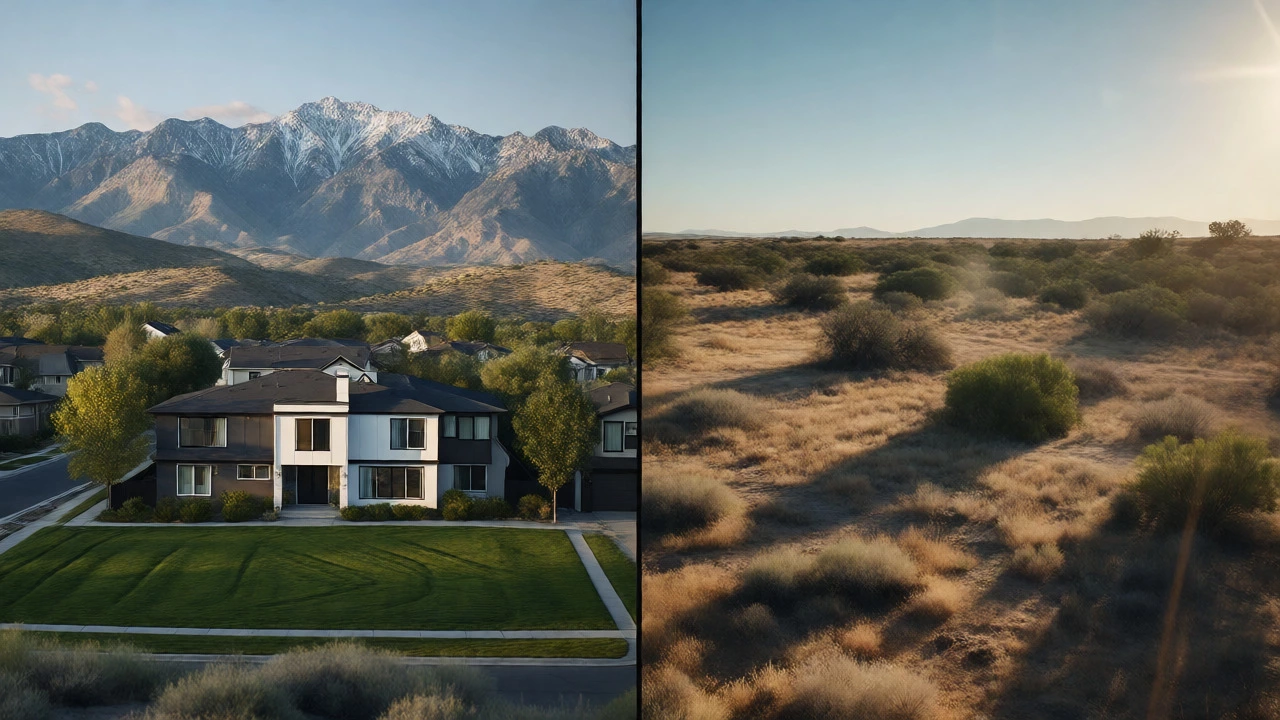
Utah vs. Texas Cost of Ownership Calculator
Enter your estimated home value to see how property taxes, insurance, and utility costs compare between the two states over time.
Home Details
Monthly Cost Breakdown
| Expense | Utah | Texas |
|---|---|---|
| Enter values and click Calculate | ||
Verdict:
Annual Difference
$0
Difference in yearly carrying costs (Tax + Ins + Util)
Total Over 10 Years
$0
Cumulative difference based on input years
You’re staring at two listings on your screen. One is a half-acre plot in the foothills of Salt Lake City. The other is five acres of scrubland outside Austin. On paper, the Texas dirt looks like a steal-way more space for less cash. But here’s the kicker: when you factor in property taxes, insurance, and utility bills, that "cheap" Texas land might actually cost you more every single month than its pricier Utah counterpart.
This isn’t just about sticker price. It’s about total cost of ownership. If you are looking to buy land for sale or build a home, choosing between Utah and Texas requires digging deeper than the listing price. Let’s break down where your money actually goes in these two very different states.
The Sticker Price Shock: Land Costs by Region
Let’s start with the obvious: raw land. If you want acreage, Texas wins on volume. You can find rural plots in West Texas for under $1,000 an acre. In contrast, finding anything comparable in Utah often means driving hours away from population centers into remote desert areas.
But most people don’t move to remote deserts; they move near jobs or schools. That’s where the math flips. In major metros, Utah’s land scarcity drives prices up sharply. A lot in suburban Salt Lake County might cost $300,000-$500,000 before you pour a foundation. In suburban Dallas or Houston, you might get similar access for $150,000-$250,000. However, as we move toward 2026, the gap has narrowed in specific pockets. Areas like Provo and Ogden have seen steady appreciation, while parts of Central Texas have cooled slightly due to oversupply.
Land Prices are highly localized. While Texas offers cheaper bulk land, Utah offers higher density value in desirable urban corridors. Always check local zoning laws, because "cheap" land in Texas might lack water rights or septic permits, adding tens of thousands to your build cost.
The Tax Trap: Why Low Home Prices Don’t Mean Low Costs
This is the biggest misconception about Texas. People hear "no state income tax" and assume everything is cheaper. They forget the property tax bill.
Texas consistently ranks among the highest in the nation for effective property tax rates, often hovering around 1.8% to 2.0%. Utah, meanwhile, sits much lower, typically around 0.6% to 0.7%. Let’s run the numbers on a $400,000 home:
- Texas: ~$7,200 per year in property taxes.
- Utah: ~$2,400 per year in property taxes.
That’s a $4,800 annual difference. Over ten years, that’s nearly $50,000 out of your pocket. To break even on this tax difference, your home in Texas needs to be roughly 25-30% cheaper than the equivalent home in Utah. For many buyers, especially those moving upmarket, Texas homes aren’t *that* much cheaper, making Utah’s low tax burden a massive long-term financial advantage.
Insurance Nightmares: Weather Risks and Premiums
If you live in Texas, you pay for weather. Hailstorms in North Texas and hurricanes along the Gulf Coast drive insurance premiums through the roof. According to recent industry data, average homeowners insurance in Texas can range from $2,000 to over $3,500 annually, depending on location and coverage type.
Utah has its own risks-earthquakes and wildfires-but they don’t hit insurance rates quite as hard across the board. Average premiums in Utah generally sit between $1,000 and $1,500. Again, you’re looking at a potential $1,000+ annual savings just by insuring your home in Utah rather than Texas.
When you combine high property taxes and high insurance costs, the "hidden" monthly carrying cost of owning a home in Texas can exceed $600 more per month than in Utah for similar property values. This is why smart buyers look at the total monthly obligation, not just the mortgage payment.
| Cost Factor | Utah (Avg) | Texas (Avg) | Difference |
|---|---|---|---|
| Property Tax | $200/mo | $600/mo | +$400 in TX |
| Home Insurance | $100/mo | $250/mo | +$150 in TX |
| Utilities (Est.) | $150/mo | $200/mo | +$50 in TX |
| Total Monthly | $450 | $1,050 | +$600 in TX |

Utilities and Climate: Heating vs. Cooling
Climate dictates your energy bill. Utah winters are cold. You’ll spend heavily on natural gas or electric heating from November to March. Summers are dry and hot, but nights cool down significantly, reducing AC strain.
Texas summers are brutal. Air conditioning runs almost continuously from May to October. In South Texas, humidity makes cooling even more expensive. While winter bills in Texas are negligible, summer spikes can offset those savings quickly. Overall, utility costs are fairly comparable, with Texas edging out slightly higher due to extended AC usage. However, if you choose a passive solar design in Utah, you can mitigate heating costs effectively.
Lifestyle Costs: Groceries, Gas, and Entertainment
Here’s where things get subjective. Texas has no state income tax, which boosts take-home pay for W-2 employees. If you earn $100,000, you keep more cash in your pocket in Texas than in Utah (which has a flat 4.85% income tax). For high earners, this tax savings can outweigh the higher property taxes and insurance.
However, everyday costs vary. Gasoline is generally cheaper in Texas due to proximity to refineries and lower state taxes. Groceries are comparable, though fresh produce tends to be slightly cheaper in Texas due to agricultural output. Entertainment varies wildly: Austin and Dallas offer vibrant nightlife and events, while Salt Lake City offers world-class skiing and outdoor access. If you ski, Utah’s proximity to resorts saves you travel costs compared to flying from Texas.

Job Market and Salary Growth
Why do people move? Jobs. Texas boasts a massive job market, particularly in tech, energy, and healthcare. Cities like Austin, Dallas, and Houston attract huge corporate headquarters. Salaries tend to be higher to compensate for the lack of state income tax and higher cost of living in urban centers.
Utah’s economy is smaller but growing fast, driven by tech (the "Silicon Slopes"), outdoor recreation, and healthcare. Salaries are competitive but generally lower than in major Texas metros. If you work remotely, Utah’s quality of life and lower carrying costs make it attractive. If you need local employment, Texas offers more volume and variety, especially in specialized industries.
Verdict: Who Wins?
So, is it cheaper to live in Utah or Texas? It depends entirely on your profile.
Choose Texas if: You are a high-income earner who benefits significantly from no state income tax. You prefer larger lots and don’t mind paying higher property taxes and insurance. You work in industries concentrated in major Texas metros.
Choose Utah if: You want lower monthly carrying costs (taxes + insurance). You prioritize outdoor access and community stability. You are sensitive to high property tax bills and prefer a predictable annual budget. You plan to stay in one place long-term, allowing the tax savings to compound.
For pure land acquisition, Texas is cheaper. For long-term wealth preservation through lower holding costs, Utah often wins. Run your own numbers using the table above. Don’t let the "no income tax" slogan blind you to the reality of your monthly bank statement.
Which state has higher property taxes, Utah or Texas?
Texas has significantly higher property taxes. Effective rates in Texas often range from 1.8% to 2.0%, while Utah’s rates are typically between 0.6% and 0.7%. This means a homeowner in Texas pays roughly three times more in property taxes than a homeowner in Utah with a similarly valued property.
Is it cheaper to buy land in Texas or Utah?
Generally, raw land is cheaper in Texas, especially in rural areas where you can buy acres for low prices. Utah has limited arable land and higher demand near urban centers, driving up per-acre costs. However, within major metropolitan suburbs, the price gap narrows, and Utah may offer better value for developed lots.
Does Texas have a state income tax?
No, Texas does not levy a state individual income tax. Utah has a flat state income tax rate of 4.85% as of 2026. High earners may save substantial amounts in Texas, but this benefit must be weighed against higher property taxes and insurance costs.
Are utility costs higher in Texas or Utah?
Utility costs are comparable but differ seasonally. Texas has higher air conditioning costs during long, hot summers. Utah has higher heating costs during cold winters. Overall, Texas tends to have slightly higher annual utility bills due to the intensity and duration of cooling seasons, particularly in southern regions.
Which state has higher home insurance rates?
Texas generally has higher home insurance rates due to exposure to hail, windstorms, and hurricanes. Average premiums in Texas can be double those in Utah. Utah faces earthquake and wildfire risks, but these do not impact statewide averages as severely as Texas’s multi-hazard exposure.