Commercial Property Sale Estimator
1. Income & Valuation
2. Deductions & Debt
Estimation Results
*This is a mathematical estimate based on the Cap Rate formula. Actual market prices may vary.
You don't just put a price tag on a warehouse or an office block and hope for the best. Unlike a house, where you look at what the neighbor sold their place for, commercial real estate is an investment. The money you walk away with depends almost entirely on how much cash the building generates every month. If your property isn't making money, it's just a shell of bricks and mortar, and the price will reflect that.
Quick Takeaways
- Your profit is based on the income the property generates, not just the square footage.
- The Capitalization Rate (Cap Rate) is the primary tool used to determine the final sale price.
- Net Operating Income (NOI) is the number that actually matters to buyers.
- Taxes, agent commissions, and closing costs will eat a significant chunk of your gross sale price.
- Property condition and lease terms can swing the price by hundreds of thousands of dollars.
The Magic Number: Net Operating Income
Before you even think about the sale price, you need to find your Net Operating Income (NOI). NOI is the total amount of income a property generates after operating expenses are paid, but before taxes and mortgage payments. This is the baseline for everything else.
Imagine you own a small retail strip in London. If your tenants pay you £100,000 a year in rent, but you spend £30,000 on insurance, property taxes, and maintenance, your NOI is £70,000. A buyer doesn't care that you paid £2,000 a month for your own mortgage-that's your personal debt, not the building's expense. They only care about that £70,000.
To get this right, you need a clean profit and loss statement. If your books are a mess, a savvy buyer will likely lowball you because they can't verify the income. Be specific about what you're deducting. Don't include one-time capital improvements, like a brand new roof, in your operating expenses, as that can artificially lower your NOI and, consequently, your sale price.
Understanding the Cap Rate
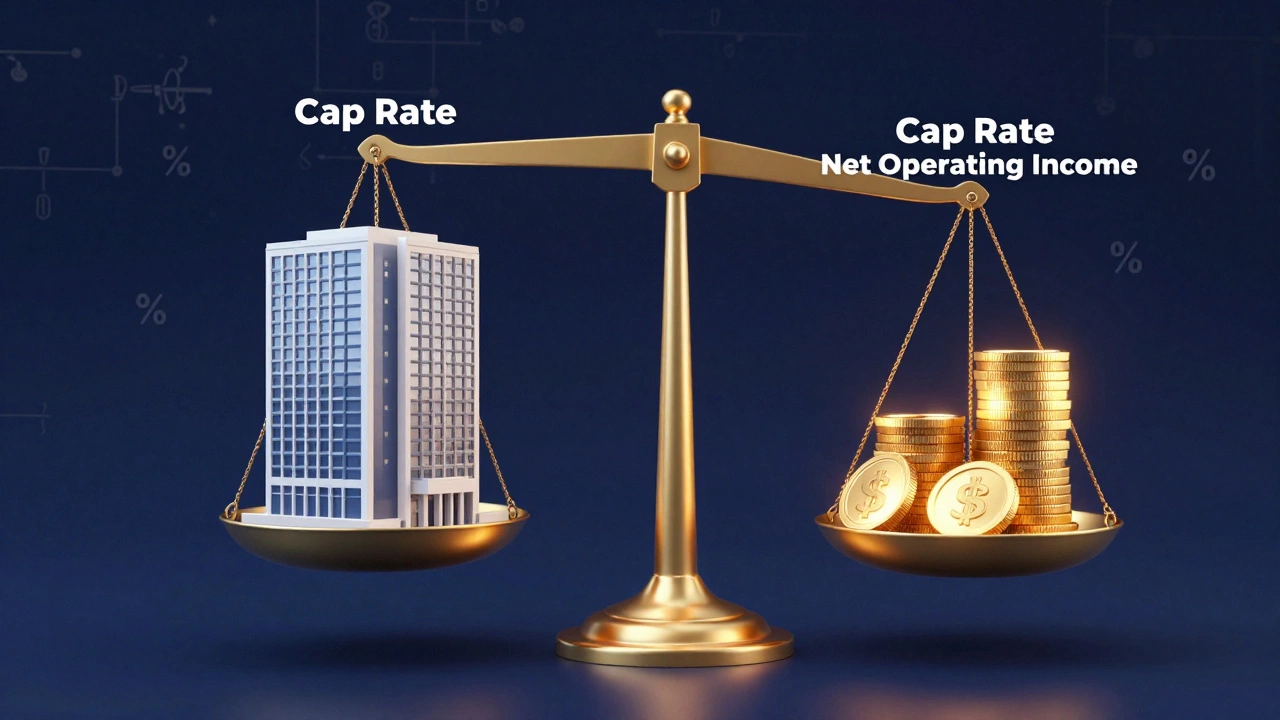
Once you have your NOI, you need to apply a Cap Rate. This is essentially the expected rate of return a buyer wants for taking on the risk of owning your property. In simple terms, the Cap Rate is the ratio between the NOI and the property value.
The formula is simple:
Property Value = NOI / Cap Rate
Let's use our £70,000 NOI example. If the current market Cap Rate for retail space in your area is 6% (or 0.06), the math looks like this: £70,000 / 0.06 = £1,166,667. If the market is hotter and the Cap Rate drops to 5%, your property is suddenly worth £1,400,000. A tiny change in the percentage leads to a massive change in the cash you get at the end.
| Market Condition | Cap Rate | Estimated Sale Price | Risk Level |
|---|---|---|---|
| High Demand/Low Risk | 4% | £1,750,000 | Low |
| Stable Market | 6% | £1,166,667 | Moderate |
| High Risk/Declining Area | 9% | £777,778 | High |
Factors That Push Your Price Up or Down
The Cap Rate is a great starting point, but it's not the whole story. A few specific variables can either add a premium to your price or force you to slash it.
First, look at your Lease Agreements. A building with a 10-year lease signed by a credit-worthy company like Amazon or Tesco is worth significantly more than one with three different tenants on month-to-month agreements. Why? Because the income is guaranteed. This is often called a "Triple Net Lease" (NNN) setup, where the tenant pays for taxes, insurance, and maintenance, meaning the owner keeps almost 100% of the rent as NOI.
Second, consider the Physical Condition. If your HVAC system is 20 years old and the parking lot is full of potholes, the buyer will subtract the cost of those repairs from your offer. They aren't just guessing; they'll bring in inspectors to create a detailed list of "deferred maintenance." If you spend £20,000 fixing the roof now, you might be able to increase the sale price by £50,000 because you've removed the risk for the buyer.
Lastly, think about the "Highest and Best Use." Is your office building sitting on land that could be turned into luxury apartments? If so, a developer might buy it based on the land value rather than the current rental income. In this case, you move away from Cap Rates and look at price per square foot of land.
The Gap Between Gross Price and Your Actual Check
The number you agree upon in the contract is not the amount of money that hits your bank account. There is a significant gap between the gross sale price and your net proceeds.
The biggest hit is usually the broker's commission. Most commercial agents charge between 3% and 6% of the sale price. On a £1.2 million sale, a 4% commission is £48,000. Then you have legal fees for the conveyancing process and potential VAT obligations depending on the structure of the sale (such as selling the property as part of a limited company).
Don't forget the mortgage. If you still owe £500,000 on a commercial loan, that comes right off the top. Some loans also have "prepayment penalties" if you sell before the term ends. Check your loan documents for a "yield maintenance" clause, which can cost you thousands if you exit the loan early.
Here is a realistic look at the leakage from a gross sale:
- Gross Sale Price: £1,200,000
- Broker Commissions (4%): - £48,000
- Legal & Admin Fees: - £5,000
- Mortgage Payoff: - £500,000
- Prepayment Penalty: - £10,000
- Estimated Net Cash: £637,000

How to Maximize Your Walk-Away Amount
If you want to get the most money, you have to stop thinking like a landlord and start thinking like a fund manager. You need to increase your NOI before you list the property. Even a small increase in monthly rent can lead to a huge jump in valuation because of the way Cap Rates multiply.
For example, if you manage to raise the rent across your units by just £500 a month, your annual NOI increases by £6,000. At a 5% Cap Rate, that small rent bump adds £120,000 to the overall value of the building. It's a massive return on a tiny amount of effort.
Another strategy is to clean up your leases. If you have "loose" agreements, tighten them up. Move as many expenses as possible to the tenant. The shift from a "Gross Lease" to a "Modified Gross" or "Triple Net Lease" makes your income stream more predictable, which lowers the buyer's risk and lowers the Cap Rate they apply, driving your price up.
Does the location affect the Cap Rate?
Yes, absolutely. A property in a prime London district like Canary Wharf will have a much lower Cap Rate (meaning a higher price) because the risk is lower. A similar building in a struggling industrial town will have a higher Cap Rate because the buyer is taking a bigger gamble on future occupancy.
What happens if my property is vacant?
If the property is vacant, you can't use the income approach (NOI/Cap Rate). Instead, it is valued using the "Comparable Sales Approach," which looks at the price per square foot of similar vacant properties that sold recently. Vacant properties usually sell for significantly less than occupied ones because the buyer has to pay the operating costs themselves until they find a tenant.
Is the sale price the same as the market value?
Not necessarily. Market value is an estimate of what a typical buyer would pay. The actual sale price is what a specific buyer is willing to pay on a specific day. This can be influenced by the buyer's specific needs-for instance, if a buyer needs a warehouse exactly where yours is located to expand their current business, they might pay a premium well above the market value.
How long does it take to actually get the money?
Commercial deals take much longer than residential ones. From the moment you accept an offer, the "due diligence" period can last 30 to 90 days. The buyer will scrutinize your leases, environmental reports, and zoning laws. You generally receive the funds upon the legal completion of the sale, but the gap between the agreement and the payday can be several months.
Should I hire a specialized commercial broker?
Yes. Commercial real estate is a different beast than residential. A specialized broker has access to the networks of investors and developers who understand Cap Rates and NOI. They can help you package your financial data to make the property look as attractive as possible, which often earns you more than the cost of their commission.
Next Steps for Sellers
If you're planning to sell, don't start by listing the property. Start by auditing your finances. Gather every lease agreement and every utility bill from the last three years. Create a clean spreadsheet that shows exactly how much money is coming in and exactly where it is going. This transparency builds trust with buyers and prevents them from using "uncertainty" as a reason to drop the price.
Depending on your situation, you might want to consider a "lease-up" strategy. If you have high vacancy, spending a few months aggressively filling those spaces-even at a slightly lower rent-will dramatically increase your NOI and your final sale price. It's better to sell an occupied building at a 5% Cap Rate than a vacant building at a price-per-square-foot discount.