Rental Property Profitability Calculator
Enter your property details below to estimate monthly cash flow, annual returns, and how long it will take to recover your initial investment.
Monthly Cash Flow
Annual Metrics
Break-Even Timeline
Time to recoup initial cash investment via net cash flow:
Enter your property details and click "Calculate Profitability" to see results.
You just closed on that duplex. The keys are in your hand, the tenants are moving in, and you’re checking your bank account every morning, waiting for the first rent check to hit. But here’s the cold hard truth: you probably won’t see a dollar of net profit in your pocket for at least six months, maybe even two years. Why? Because "profit" in real estate isn't just rent minus mortgage. It’s a complex equation involving vacancy rates, maintenance surprises, tax implications, and the slow grind of equity buildup.
If you’re asking how long it takes to make money on a rental, you’re likely conflating three different things: positive cash flow, total return, and realized gains. Most beginners expect immediate monthly income. In reality, the first year is often about survival-covering unexpected repairs and stabilizing occupancy. The real payoff usually comes later, either through consistent monthly surplus or, more commonly, through appreciation and equity paydown over five to seven years. Let’s break down the actual timeline so you don’t quit before the magic happens.
The Myth of Immediate Cash Flow
Let’s kill the biggest misconception right now: buying a rental doesn’t mean instant passive income. When you buy a property, you sink a massive amount of capital into the down payment, closing costs, inspections, and initial repairs. That money is gone from your liquid accounts. To get it back, you need the property to generate enough net operating income (NOI) to cover its own expenses plus provide a surplus.
In the first 12-24 months, most properties operate at break-even or slightly negative cash flow. Why? You’re dealing with "teething issues." The HVAC unit fails. The tenant leaves after three months, forcing you to pay for turnover costs like painting and cleaning. You haven’t yet built up a reserve fund. If you bought a fixer-upper, those renovation costs might not be fully depreciated or offset by higher rents immediately. So, if you look at your bank statement in month six and see $0 profit, don’t panic. That’s normal. You’re building the foundation.
Consider this scenario: You buy a single-family home for $300,000 with a $60,000 down payment. Your monthly mortgage, taxes, insurance, and HOA fees total $2,200. You rent it for $2,500. On paper, you have $300 in cash flow. But subtract a 5% vacancy allowance ($125), a 5% maintenance reserve ($125), and property management fees (8%, or $200). Suddenly, your "profit" is negative $150 per month. You are technically losing money on cash flow while paying down debt. This phase can last until rents rise or vacancies stabilize.
Cash-on-Cash Return vs. Total Return
To understand when you actually profit, you need to distinguish between two metrics: Cash-on-Cash Return and Total Return. Beginners obsess over Cash-on-Cash. It’s simple math: Annual Net Cash Flow divided by Total Cash Invested. If you put in $60,000 and get $3,600 in annual cash flow, your return is 6%. Not bad, but not exactly getting rich quick.
Total Return is where the real wealth hides. It includes four components:
- Cash Flow: The actual money hitting your account.
- Loan Paydown: Every month, your tenant pays part of your principal balance. This builds equity without you writing a check.
- Depreciation: A non-cash tax benefit that reduces your taxable income, effectively keeping more of your cash flow in your pocket.
- Appreciation: The increase in property value over time.
Here is the kicker: Loan paydown and depreciation often make a property profitable on paper even if cash flow is zero. For example, if your tenant pays $1,000 toward principal each month, that’s $12,000 in equity gain annually. Add $10,000 in depreciation benefits, and suddenly your "paper profit" is huge, even if your bank account didn’t grow. However, you can’t spend paper profit. You can only spend cash flow or sell the asset. Therefore, true liquidity-based profit usually lags behind accounting profit by several years.
The Break-Even Point: Recovering Your Initial Investment
When do you get your original money back? This is called the break-even point. If you invested $70,000 all-in (down payment + closing + repairs), and your average annual net cash flow is $4,000, it will take 17.5 years to recoup your initial cash outlay solely through rent checks. That sounds terrible, right?
But wait. We forgot appreciation. If the property appreciates at 3% annually, which is a conservative historical average in many US markets, that $300,000 home becomes worth $390,000 in ten years. Now, combine the $40,000 in recovered cash flow with $90,000 in equity growth. Your total return on investment is massive, but it’s locked inside the house. You realize this profit only when you sell or refinance.
So, the timeline depends on your exit strategy:
- Long-term Hold (10+ years): You profit slowly via compounding equity and modest cash flow. The "profit" is realized at sale.
- Refinance Strategy (3-5 years): You use forced appreciation (renovations) to pull out cash. This accelerates profit realization but requires high skill and market timing.
- House Hacking: Living in one unit and renting others can turn cash flow positive in year one because you eliminate the largest expense: your primary residence cost.
Factors That Speed Up or Slow Down Profitability
Not all rentals are created equal. Several variables dictate how fast you see green numbers.
Location Quality: Class A neighborhoods (new builds, low crime, good schools) offer stable tenants and lower vacancy but lower cash flow yields (often 4-6%). Class C neighborhoods (older homes, higher turnover) offer higher yields (8-12%) but come with frequent repairs and evictions. High-yield areas might show cash profit faster but eat into margins with maintenance headaches.
Leverage: Using other people’s money amplifies returns. If you put 20% down, a 3% appreciation on the asset equals a 15% return on your equity. But leverage also magnifies risk. If values drop, you lose equity faster than an owner who paid cash. In high-interest-rate environments (like we saw in 2023-2025), high mortgage payments crush cash flow, pushing the profitability timeline out by years compared to the low-rate era of 2010-2021.
Property Type: Single-family homes appreciate better and attract longer-term tenants, slowing turnover costs but offering lower immediate cash yield. Multi-family units (duplexes, fourplexes) scale better; you can raise rents on multiple units simultaneously, accelerating cash flow recovery. Commercial properties typically require longer leases (5-10 years), providing stability but less flexibility to adjust rents quickly during inflation spikes.
| Strategy | Initial Cash Flow | Time to Stabilized Profit | Risk Level |
|---|---|---|---|
| Turnkey Single-Family | Negative to Neutral | 1-2 Years | Low |
| Fix-and-Hold (Value Add) | Negative (during reno) | 2-3 Years | Medium |
| House Hacking | Positive | Immediate | Low |
| Class C Multi-Family | Positive | 6 Months | High |
| New Construction | Negative | 3-5 Years | Medium |
Hidden Costs That Delay Profit
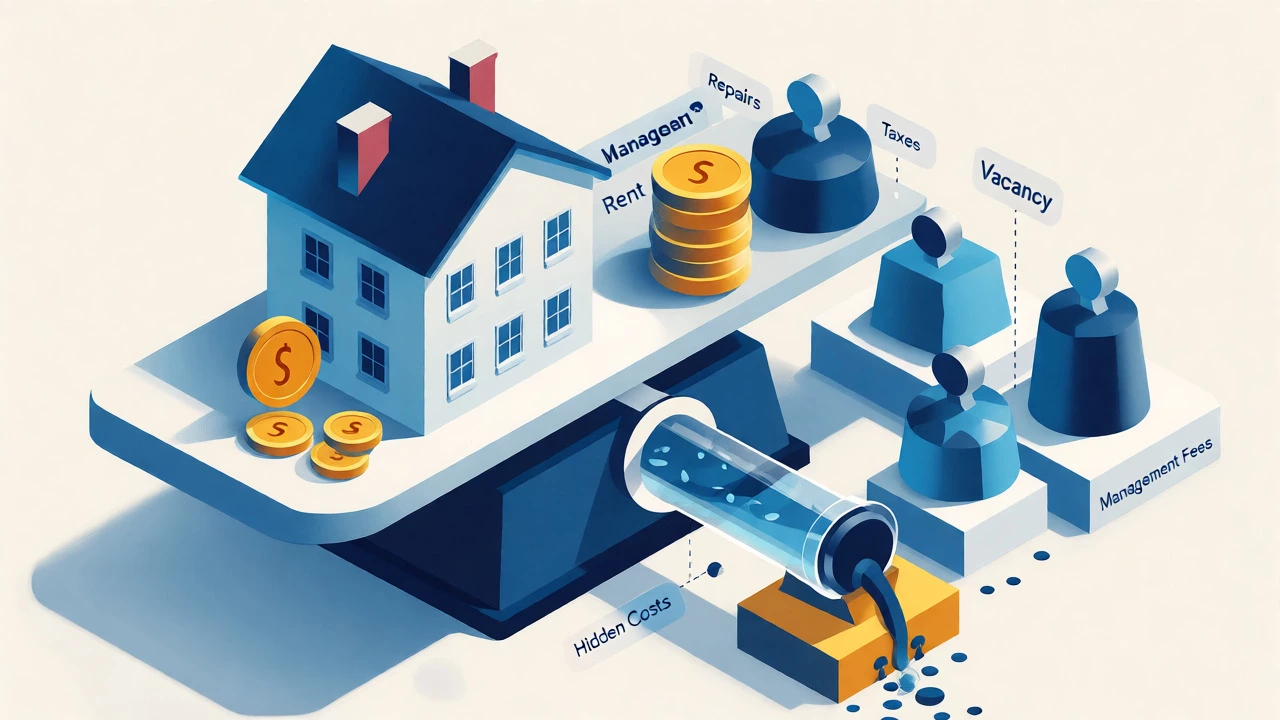
Why does your spreadsheet say $500 profit, but your bank says $0? Hidden costs. Most new investors underestimate these three killers:
- Vacancy and Turnover: Even in hot markets, expect 5-8% vacancy loss. When a tenant leaves, you pay for deep cleaning, carpet replacement, and marketing. A $300 turnover cost wipes out a month of "profit."
- Capital Expenditures (CapEx): Roofs, HVAC systems, and water heaters eventually die. They aren’t monthly bills, but they are inevitable. If you don’t set aside $200/month for CapEx reserves, a $10,000 roof replacement will destroy five years of accumulated profit.
- Management Fees: If you hire a property manager, expect to pay 8-10% of gross rent. Many owners think they can manage themselves to save this fee, but poor screening leads to bad tenants, leading to evictions, which cost thousands. Sometimes, paying the fee is the cheapest way to ensure consistent profit.
Accountants call this "accrual basis" vs. "cash basis." Real estate profits are often accrued (earned) but not received (cash) due to these reserves. To truly know when you’re profitable, calculate your "Cash Flow After Reserves." If that number is positive, you’re winning. If it’s negative, you’re subsidizing the property.
Strategies to Accelerate Your Timeline
You don’t have to wait ten years to feel successful. Here is how savvy investors shorten the path to visible profit:
Buy Below Market Value: The classic BRRRR method (Buy, Rehab, Rent, Refinance, Repeat) allows you to pull out your initial capital within 6-12 months. By refinancing based on the new, higher appraised value, you recover your down payment and rehab costs. Now, you own the property with little to no money in it. Every dollar of cash flow from that point forward is pure profit relative to your remaining equity.
Raise Rents Aggressively (But Legally): In strong markets, you can push rents to the top of the range by adding amenities like in-unit laundry or smart thermostats. A $100/month rent increase adds $1,200/year to cash flow. Over ten years, that’s $12,000 extra, significantly cutting the break-even timeline.
Optimize Financing: Shop for loans with lower points or seller financing. Reducing your closing costs by $5,000 directly increases your cash-on-cash return. Also, consider shorter loan terms (15-year vs. 30-year) if you want faster equity build-up, though this hurts monthly cash flow.
When to Consider Selling for Realized Profit
Eventually, you’ll face the decision: hold or fold? The general rule of thumb is that real estate cycles run 7-10 years. Buying at the bottom of a cycle and selling at the peak maximizes realized gains. If you’ve held a property for 5+ years, you’ve likely benefited from significant loan paydown and appreciation.
Selling triggers capital gains taxes. However, you can defer these taxes using a 1031 Exchange, rolling profits into a new, larger property. This keeps your wealth compounding rather than leaking away to the IRS. If you sell and keep the cash, remember that transaction costs (agent commissions, transfer taxes) will eat 6-8% of your sale price. Ensure your cumulative profit exceeds these exit costs before pulling the trigger.
Ultimately, making a profit on a rental property is a marathon, not a sprint. The first year is about learning and stabilizing. Years 2-5 are about optimizing operations and building equity. Years 5-10 are where the compound interest effect kicks in, turning modest monthly surpluses into substantial wealth. Don’t judge your success by month one. Judge it by year five.
Is a rental property profitable in the first year?
Rarely in terms of cash flow. Most investors experience negative or neutral cash flow in year one due to closing costs, initial repairs, and vacancy periods. However, you may see "paper profit" through loan paydown and depreciation tax benefits, even if your bank account doesn't grow.
What is a good cash-on-cash return for a rental property?
A healthy target is typically 6-8% for stabilized single-family homes in moderate markets. Higher-risk areas or multi-family deals might aim for 8-12%. Anything below 4% is generally considered underperforming unless you anticipate very high appreciation.
Does rental income count as profit immediately?
No. Rental income is revenue. Profit is what remains after deducting all operating expenses (taxes, insurance, maintenance, management fees), debt service (mortgage payments), and capital expenditure reserves. Only the net remainder is true profit.
How does depreciation affect my rental profit?
Depreciation is a non-cash expense that lowers your taxable income. For residential real estate, the IRS allows you to deduct the value of the building (not land) over 27.5 years. This means you can have positive cash flow and still report a loss on your taxes, allowing you to shelter other income.
Should I sell after 5 years to lock in profit?
It depends on market conditions and your goals. Five years is often enough to benefit from loan paydown and some appreciation, but transaction costs are high. If the market is overheated, selling might be wise. If you plan to reinvest via a 1031 exchange, holding longer usually compounds wealth more effectively.